|
|
|
|
|
JAMES
OF GLENCARR
Family tradition has it that we were connected at one time with Clan Gunn through marriage on the paternal side, but I have not been able to substantiate that assertion. It is claimed that after the failure of the rising by Owain Glyndwr at the beginning of the fifteenth century, one of our distant forebears headed from the mountains of Wales to the Scottish Highlands. Here it is said occurred a marriage with one of the women of Clan Gunn. The Clan Gunn lived in the Strath of Kildonan in the north of Scotland until they became another statistic of the Highland Clearances. It is said that at least one of the male off-spring of this Celtic union then moved to Northumberland in England, and we trace our paternal line from that particular ancestral progenitor. If the above claim holds water, it is possible that at one point our surname probably had the prefix 'ap' and most likely the older form of 'map' prior to that. In linguistic terms 'map' or 'ap' is the Brythonic (Welsh) P-Celtic version of the Gaelic Q-Celtic 'mac', meaning 'son of'. The prefix of 'ap' was dropped from many Welsh surnames in modern times as the nation became more anglicized and more English speaking, particularly in the south. Interestingly, it was not until the 16th century in Wales that fixed surnames were adopted by the upper levels of society. Prior to that they still followed the Celtic system of patronymics, similar to the 'ap' mentioned above, but unfixed. Therefore if Lloyd ap James had a son, he would become Evan ap Lloyd for example, or even Evan ap Lloyd ap James. The lower levels of society adopted fixed surnames as the centuries passed, yet even in the 19th century people could still be found in Wales using patronymic names. The surnames Jameson and Jamieson are today accepted as being official septs of Clan Gunn, and in some lists so is MacJames. There is no mention of James as a stand alone surname. It would seem logical however that our ancestor simply became fully integrated with his fellow clansmen, especially given that he would have used a patronymic at that time. It might also be of course, that those ever romantic Victorians simply didn't get around to adding it to their ever expanding lists of associated families supposedly connected with the major clans. The whole business of septs is open to controversy in any case, with some past clan historians appropriating septs, or associated families and groupings at the stroke of a pen. There is often little concrete evidence of a firm association and much of the blame here can be laid at the door of the great 19th century tartan obsession, and a wish by educated Victorians to belong to a clan. The surname of James does tend to be clustered now in one area of Scotland in particular, that being Angus. In Fife however, geographically close to Angus, James is ranked as only the 83rd most popular surname. It is unclear from which exact root this surname stems in Scotland, but probably a combination of more than one. Our particular family surname is rooted in Wales. It may well of course have travelled north as a given name through the migration of a branch of the family in earlier times as already mentioned, but with respect to our ancient forebear, logic dictates that given the naming system in Wales at the time, our ancestor may well have travelled north in accordance with family tradition, but he would not have done so with a fixed surname. James has also been a popular Christian name for centuries in Scotland, especially amongst royalty, and is still extremely popular to this day. James appears to be one of those enduring names that stands the test of time and does not come and go like so many 'fad' names. James of Northumberland One of the earliest fully documented James ancestors we have uncovered to date was born in 1638, during the reign of Charles I. This ancestor was called Thomas James. He lived in the village of Hebburn (Hebron) Northumberland, which is geographically close to the town of Morpeth. He was the Parish Clerk of Hebburn from 1682 - 1718, which at that time was a religious office and he would have been ordained into minor orders. His son, also called Thomas, became Parish Clerk in turn from 1718 - 1752. It is from the second Thomas that our direct line springs, from his first son who was called Henry. Henry we believe was apprenticed to a Miller, but we are in the process of confirming that. Henry's son, William 1749 - 1832 was most certainly a Miller by trade. This trade was then passed down to his son, Edward James, who was born in 1780 in the village of Whalton, Northumberland. Subsequently he relocated to Newcastle Upon Tyne and died in 1857 at the grand old age of 77. The son of Edward the Miller, also called Edward, did not take up his fathers milling trade but instead became a Greengrocer and then a Locomotive Engine Driver, in the exciting new world of the railways. By the 1820's, Newcastle was an expanding industrial powerhouse that was drawing in labour from all over the British Isles. It was a city built on coal, shipbuilding, chemicals and all kinds of heavy engineering enterprises. The population of the city was growing rapidly, in 1801 it stood at 33,322 and by 1851 it had risen to 80,184. By the end of the century it had reached 246,905. By
the middle of the 19th century, Newcastle Upon Tyne had become a fetid
place, like so many of the industrialised cities. In a report for the
government written in 1845 called, 'Report on the state of
Newcastle Upon Tyne and other large towns', it said of Newcastle: ‘Pandon Dene, on the east side of the town has now become little better than a public sewer’. The author of the report also stated that: 'The water
supply was a total disgrace, being contaminated with excrement and other
matters from the common sewers. Living conditions in the poor parts of
the town like All Saints and St John’s were damp and squalid inside
and no better outside, where filth and refuse accumulate in the lanes
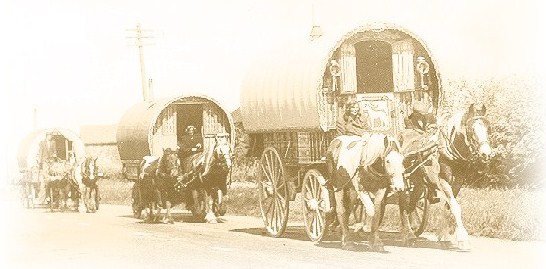
and vacant corners'. Edward the Locomotive Engine Driver was riding the footplate of an awesome new technology, living the exciting early days of steam and the expansion of the railways. In the early 1840's he appears to have married Anna Waldren, who was probably from a town in Hampshire. As of yet, I have been unable to find a marriage record. They moved to Norwich in Norfolk between 1847 and 1850. He is supposed to have died in 1860 at the age of 40, but as of this point in time, a record of his death has yet to be found. After Edwards supposed tragic early death the family moved first to Lambeth in Surrey - which is now part of south London. They then moved again a few years later to Basingstoke in Hampshire, where in 1871, Anna is recorded as being the head of the family. A Colourful Travelling Life Edward the Locomotive Engine Driver had a son, also called Edward, who was born in Basingstoke, Hampshire in 1847. It appears that this Edward, our direct paternal ancestor, became a part of the travelling community and earned a living as a travelling showman. How this occurred I have no direct knowledge as yet, but it sounds like an adventure. In 1866 he married a girl by the name of Anna (Hanna) Canty from an Irish Catholic family. Her father, Michael Canty, was born in Knightsbridge, Middlesex in 1831. He married Catherine Long, a girl from County Limerick, Ireland at St Mary's Catholic Chapel in Chelsea, Middlesex on the 1st June 1851. Among their children they had a son, my great-grandfather whom they also called Edward. This Edward grew up in the travelling tradition and he became a highly skilled master craftsman who built traditional horse-drawn caravans, which he displayed at the traveller fairs such as that held during the summer at Epsom Downs in Surrey. In the 1901 census I have him listed as living on a caravan encampment at Crown Wharf in Erith, Kent, England. In the 1911 census he is listed as a Travelling Showman and his residence is given as 'in a field off High Street, Stratford' (Stratford is in the East End of London and is where the 2012 Olympic Games took place). There can definitely be no doubt about the travelling credentials of Edward James.
In 1893 at the age of 23 he married a 20 year old Irish girl called Kathleen Amelia Farral (Farrell), who I am reliably informed by the family was a strict, practicing Roman Catholic. She had a pretty fiery temperament too by all accounts and was a bit of a handful to say the least. It does seem that Edward had grown up as a Catholic, most likely as a result of living in a travelling fairground community with a strong Irish tradition. I have no idea of the religion of Edward the locomotive driver, but I would imagine he was Church of England, given the family history. His son Edward, began his working life as a 'Railway Odd Boy' whatever that is, at the age of 14. As already stated, I have no exact idea of how or why he became connected with the travelling community, maybe he simply wanted a more exciting life? Our lives tend to have a way of springing all kinds of surprises and opening many unexpected doors, which is what makes it such a fascinating journey along the meandering path of life. My grandfather was called Joseph, he was a younger son so escaped being called Edward. The oldest son was called Edward though, and I have corresponded with a descendent of his via the Ancestry website. Our paternal DNA is identical as we share the same grandfather. My own son is also called Edward, so the name is still travelling forward along our James ancestral line. Joseph was always known by his second name though, Francis, which was shortened to Frank. He moved away from the showman lifestyle of his forebears when he was older, and became settled. He still had a very large family though and was of course a Catholic, although not a particularly devout one as far as I am aware. He did not however lose his connections with the travelling community. Some members of my family still speak the English Romany language, as many showmen did back then. Despite becoming settled, we are still deeply attached to our past and to the rich tapestry of our ancestry that has made us what we are today. Showmen have for some time begun to distance themselves from other Travellers, as they don't want to be associated with the blackened reputation attached to other Travelling peoples in the UK. That I feel is a great shame, as there has always been a close connection between Showmen and English Romany's, inter-marriage was not uncommon. To most 'house people' all Travellers are of the same stamp anyway, and get tarred with the same brush, regardless of how each culture and tradition may seek to differentiate themselves. My father is a pretty luke warm Catholic, so the old religion on the paternal side of my family has become diluted with the passing of the generations. He is also less of a traveller, although he did begin his working life as a showman in a fairground community that was mainly of Irish origin. A continuation of old family contacts and tradition. He told me that his father, my grandfather, had said to him - 'once a traveller, always a traveller' - meaning that it is a matter of blood, tradition, community and kindred. I have spent a lot of my life travelling around the world and living and working overseas, so I imagine there must still be a fair sprinkling of those wandering traveller genes within my genetic make-up. I do sometimes wish I had a bit more of that famous 'luck of the Irish' about me at times, to go alongside my Irish genetic inheritance. Still, as long as one enjoys good health, marital happiness and robust children, everything else in life is simply an added bonus. Dispossession The 'Glencarr' designation for our family is originally from the maternal side. This is believed to refer to the dispossessed land from which our maternal forebears originated. This dispossession appears to have taken place some time after 1603 and the joining of the crowns, when certain major Border Reiver Heidsmen, looking to their own best interests and noble advancement, speedily abandoned loyalty to those of their own surname and transferred it to the crown. For the opportunistic and self-interested Heidsmen, this brought rewards of noble titles and land, much of which had been seized from those families accused of being Reivers. Many of those so accused had been treated to the immediate and summary execution 'Jeddart Justice' of King James VI/I. It was a brutal end to an often brutal era, yet one which spawned amazing ballads and poetry, and tales of fiercely independent men and strongly bonded extended families. We cherish the historic connection to our lost ancestral land, although it is purely an academic exercise in all respects today. However, we still have a deep sense of being firmly rooted to a certain place and time, and to a more bold and simple way of life. We may hopefully at some point discover the exact location of Glencarr, and be able to reacquire at least some of that lost land and so complete a very old family circle. I have travelled to the Border area many times, and visited our former lands and dwelling places, and spent time at the graveside of my oldest documented forebear. I would love to relocate to that location with my family, but it isn't really practical at this time as realistic work opportunities are pretty scarce. In the meantime we do own a souvenir plot of land in Scotland, enough to keep a foot north of the border, well 9sq feet to be precise. No, it isn't one of those 'buy a tiny speck of Scotland for a large sum of money and call yourself a Laird' plots of land, sold by money grubbing opportunists and aimed at the romantic and gullible. No, our plot does exactly what it says on the tin and carries no ridiculous Lairdly pretences. The funds raised are used for important conservation work in a very lovely part of the Highlands. We take a great pride in our family history as when all is said and done, ones family, surname and sense of belonging are what really matter in life, not the baubles and trinkets we all too often surround ourselves with in order to meet societies expectations of what success should mean. We are not altogether sure of the exact original location for our paternal forebears in north Wales, but it is traditionally (and speculatively) supposed to be in the area around Capel Curig in the ancient Principality of Gwenydd. It is a beautiful and mountainous part of Wales and is now best known as the climbing centre of Snowdonia. I have actually visited Capel Curig in the past, and climbed in the area. That Clan Gunn connection we mentioned earlier may be yet another one of those heavily romanticised tales wrapped up in the plaid of the Scottish revival, and may never be fully explained to everybody's complete satisfaction, but It makes for a good discussion around the family hearth if nothing else, and fact can sometimes be far stranger than fiction when it comes to family ancestry.
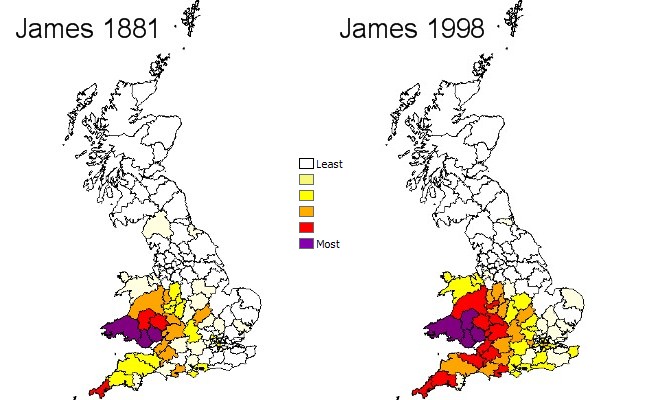
The
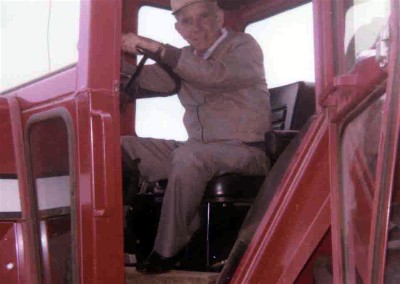
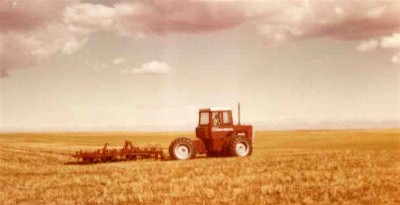
Distribution of the James surname in the UK 1881 and 1998 Border Reivers On the maternal side, as previously mentioned, we are directly descended from the border Surname of Kerr. The Kerrs were one of the most notorious and successful families of Border Reivers, based in the Middle March north of the Border. The bulk of the Kerrs (Carrs) associated with us remain in Canada after seeking a better life there in the 19th and early 20th centuries. The family spent decades going to and fro to Canada but one branch of the family eventually returned to the UK and that is where we trace our modern lineage from. One very interesting phenomenon we discovered whilst perusing old family photographs, many going back to second half of the 19th century, was that of the 'Carr ears'. There is a definite genetic trait that runs in the male Carr line and even though I myself am a James on the paternal side, I still seem to have inherited the 'Carr ears' from the maternal side. It must be a powerful gene. Ancestry and DNA recombination can be such a fascinating subject that throws up all kinds of surprises. The Kerrs (Carrs) that remained in Canada spread out over that country and became very successful wheat farmers on the prairie lands of Saskatchewan. My great-grandfather served with the Canadian army in the Great War of 1914-18 and saw action at The Somme and at Vimy Ridge, although wounded in action after Vimy, he did thankfully survive the war, having been awarded the Military Medal for bravery on the battlefield. My grandfather returned to England prior to the beginning of the second world war. Upon the commencement of hostilities he joined the British Army and spent six years away from home, ending his military service in India as that country drew towards independence. He was demobbed at the rank of WO1 in 1946, and settled back into civilian life in the UK. Having had many discussions with my grandfather, I believe he regretted not returning to Canada after WW2, but I think my grandmother was reluctant to relocate. I was able to travel with my grandfather to Canada at the end of 1990 and meet some of my distant relatives. I was even offered work in Calgary, and support if I wished to emigrate to that vast country. My circumstances were not conducive to that at the time unfortunately, but I very much enjoyed my vacation to that wonderful part of the world. It was also the last time my grandfather had the chance to travel to see his family, as he sadly passed away suddenly and unexpectedly the following year. It was a terrible emotional blow for me, as we had been very close. The previous time he had been able to make the trip was in 1980 and below are two photographs taken of him on a piece of agricultural machinery during that visit, on the very large family farm near Saskatoon in Saskatchewan.
My grandfather, Donald Carr, on the farm in Saskatchewan Today the maternal surname is spelt 'Carr', one of the four accepted versions, the others being 'Care', 'Ker' and 'Carre'. This difference in spelling is often historical. Back in earlier times there was no set spelling of a surname. Accent's and dialects within the spoken language gave rise to these variations of the spelling. In fact, 'Carr' was probably the most common pronunciation in the 16th century, the height of the Border Reivers power and influence. The great Scottish born Hollywood actress Deborah Kerr, always insisted upon her surname being pronounced as 'Carr' in the traditional way. In our case, the spelling seems to have changed from Kerr to Carr after our family were forced from Scotland and into Cumberland, which today forms part of the modern English county of Cumbria. Why that happened we don't yet know but maybe the shadow of the noose hung over the old spelling and the new Carr spelling was adopted from Glencarr? Another mystery to solve, if we ever do but personally speaking, I believe it was simply a phonetic change caused by accent and then entered into written documentation in Cumberland as Carr instead of Kerr. To the Border families, ones name was far more important than nationality, especially as there was so much intermarriage across the border, which is still true today. The most important thing by far was loyalty to the name which one bore. Back in the time of the Border Reivers, your surname could get you killed, but it would also afford you protection from enemies.
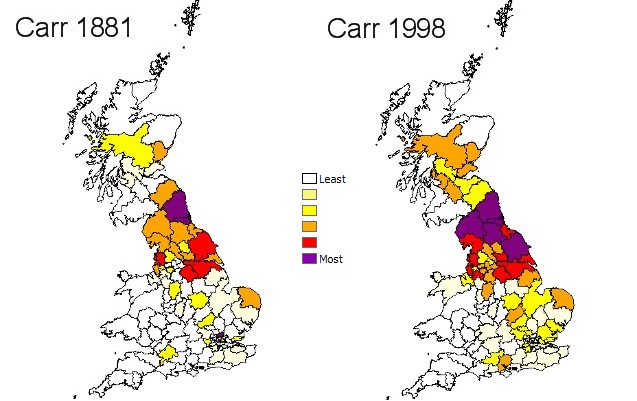
The
Distribution of the Carr surname in the UK 1881 and 1998 ©Copyright - James of Glencarr |